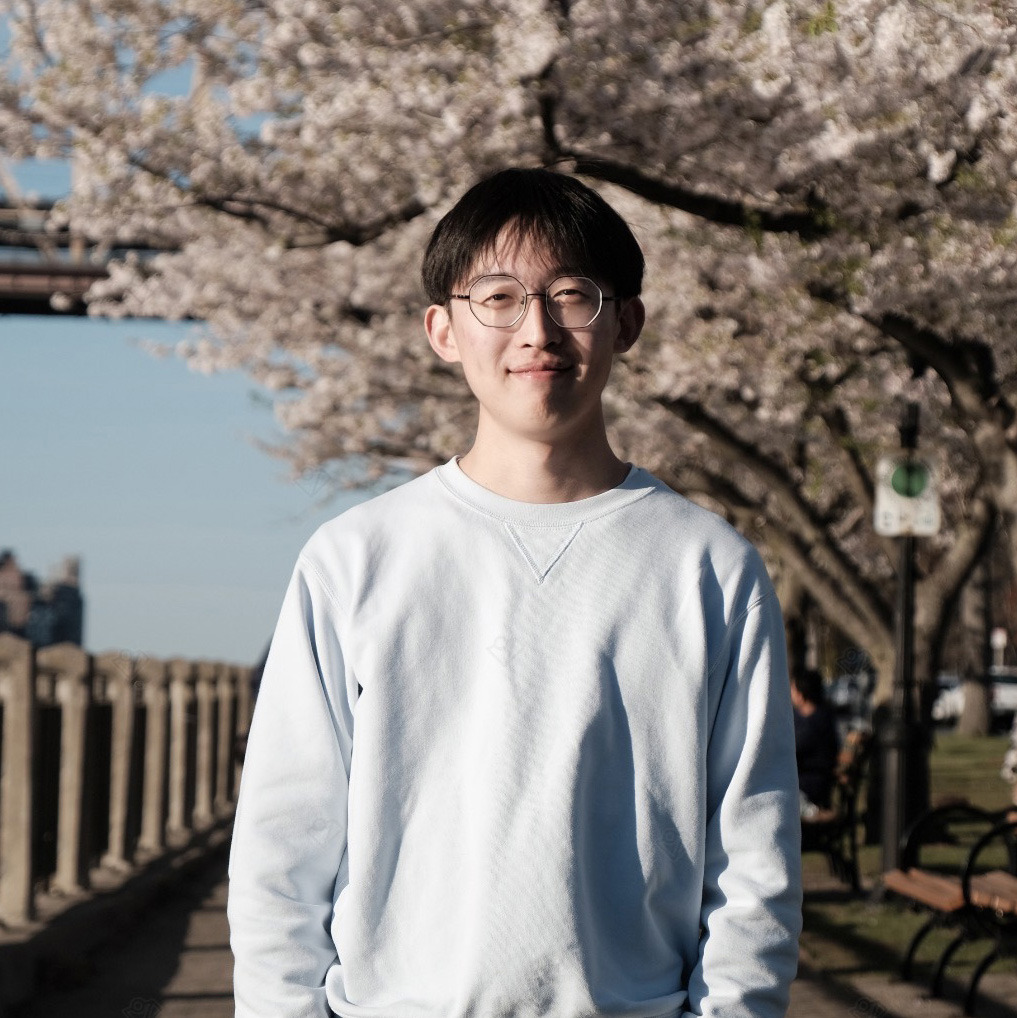
Hi there! I'm Jingyang (John) Gong, and welcome to my homepage. I’m currently a first-year PhD students in The University of Hong Kong, supervised by Prof. Reynold Cheng and Prof. Ben Kao. Before that, I earned my M.S of Computer Engineering in New York University and B.Eng of Data Science with distinction in East China Normal University.
My primary research interests is coding capability of foundational LLMs. Apart from that, I'm also interested in mechanistic interpretability and multilingual LLM.
Warning
Problem: The current name of your GitHub Pages repository ("Solution: Please consider renaming the repository to "
http://".
However, if the current repository name is intended, you can ignore this message by removing "{% include widgets/debug_repo_name.html %}" in index.html.
Action required
Problem: The current root path of this site is "baseurl ("_config.yml.
Solution: Please set the
baseurl in _config.yml to "Education
-
 The University of Hong KongDepartment of Computing and Data Science
Ph.D. StudentSep. 2026 - present -
 New York UniversityM.S. in Computer EngineeringSep. 2023 - May. 2025
 -
 East China Normal UniversityB.Eng. in Data ScienceSep. 2019 - May. 2023
Honors & Awards
-
Outstanding Graduates Award2023
-
Excellent Bachelor Thesis Award2023
Selected Publications (view all )

JanusCoder: Towards a Foundational Visual-Programmatic Interface for Code Intelligence
Qiushi Sun, Jingyang Gong, Yang Liu, Qiaosheng Chen, Lei Li, Kai Chen, Qipeng Guo, Ben Kao, Fei Yuan
ICLR 2026
The scope of neural code intelligence is rapidly expanding beyond text-based source code to encompass the rich visual outputs that programs generate. This visual dimension is critical for advanced applications like flexible content generation and precise, program-driven editing of visualizations. However, progress has been impeded by the scarcity of high-quality multimodal code data, a bottleneck stemming from challenges in synthesis and quality assessment... [SEE PAPER FOR FULL ABSTRACT]
JanusCoder: Towards a Foundational Visual-Programmatic Interface for Code Intelligence
Qiushi Sun, Jingyang Gong, Yang Liu, Qiaosheng Chen, Lei Li, Kai Chen, Qipeng Guo, Ben Kao, Fei Yuan
ICLR 2026
The scope of neural code intelligence is rapidly expanding beyond text-based source code to encompass the rich visual outputs that programs generate. This visual dimension is critical for advanced applications like flexible content generation and precise, program-driven editing of visualizations. However, progress has been impeded by the scarcity of high-quality multimodal code data, a bottleneck stemming from challenges in synthesis and quality assessment... [SEE PAPER FOR FULL ABSTRACT]
CodeEvo: Interaction-Driven Synthesis of Code-centric Data through Hybrid and Iterative Feedback
Qiushi Sun, Jingyang Gong, Lei Li, Qipeng Guo, Fei Yuan
ACL 2026
This work proposes CodeEvo, a framework that synthesizes code data through iterative interactions between two LLM agents: a Coder and a Reviewer, which guides the synthesis process by producing new instructions and feedback, and introduces a hybrid feedback mechanism that combines compiler determinism with the generative flexibility of agents, enabling automatic quality control throughout synthesis... [SEE PAPER FOR FULL ABSTRACT]
CodeEvo: Interaction-Driven Synthesis of Code-centric Data through Hybrid and Iterative Feedback
Qiushi Sun, Jingyang Gong, Lei Li, Qipeng Guo, Fei Yuan
ACL 2026
This work proposes CodeEvo, a framework that synthesizes code data through iterative interactions between two LLM agents: a Coder and a Reviewer, which guides the synthesis process by producing new instructions and feedback, and introduces a hybrid feedback mechanism that combines compiler determinism with the generative flexibility of agents, enabling automatic quality control throughout synthesis... [SEE PAPER FOR FULL ABSTRACT]
Make Prompt-based Black-Box Tuning Colorful: Boosting Model Generalization from Three Orthogonal Perspectives
Qiushi Sun, Chengcheng Han, Nuo Chen, Renyu Zhu, Jingyang Gong, Xiang Li, Ming Gao
LREC-COLING 2024
Large language models (LLMs) have shown increasing power on various natural language processing (NLP) tasks. However, tuning these models for downstream tasks usually needs exorbitant costs or is unavailable due to commercial considerations. Recently, black-box tuning has been proposed to address this problem by optimizing task-specific prompts without accessing the gradients and hidden representations. However, most existing works have yet fully exploited the potential of gradient-free optimization under the scenario of few-shot learning... [SEE PAPER FOR FULL ABSTRACT]
Make Prompt-based Black-Box Tuning Colorful: Boosting Model Generalization from Three Orthogonal Perspectives
Qiushi Sun, Chengcheng Han, Nuo Chen, Renyu Zhu, Jingyang Gong, Xiang Li, Ming Gao
LREC-COLING 2024
Large language models (LLMs) have shown increasing power on various natural language processing (NLP) tasks. However, tuning these models for downstream tasks usually needs exorbitant costs or is unavailable due to commercial considerations. Recently, black-box tuning has been proposed to address this problem by optimizing task-specific prompts without accessing the gradients and hidden representations. However, most existing works have yet fully exploited the potential of gradient-free optimization under the scenario of few-shot learning... [SEE PAPER FOR FULL ABSTRACT]